
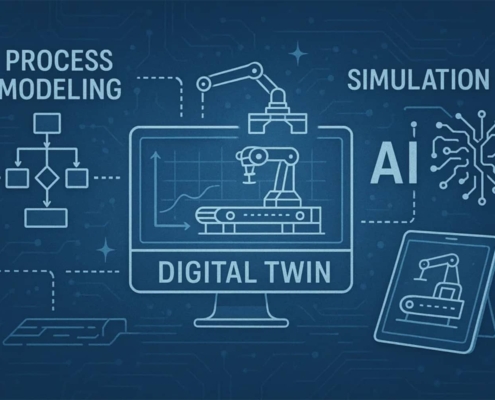
What seemed like a distant future is already here. AI Twin is our present. And if the classic digital twin is a ‘techie’ and a virtual testing ground for software copies of machines, then the AI twin is the next step. It connects resources, finances, the market and people into a single system, according to experts at Grymaxion EOOD.
The concept of digital twins has come a long way from NASA drawings in the 1960s to modern cloud systems. In fact, in 2026, business will move from stating facts to proactively modelling its profits. Using an AI twin, you can predict the consequences of any management decision. Even before the issue affects real accounts.
An AI twin imitates the actions of a person or even an entire company, modelling decision-making logic and reproducing behaviour patterns. A couple of years ago, this technology was exclusive to corporations, but today it is available to medium-sized businesses.
Who will be using AI twins in 2026, and how?
- Siemens and GE use twins to prevent turbine breakdowns.
- BlackRock (Aladdin platform): the most ambitious example of a digital twin for an investment portfolio. The system models the behaviour of millions of assets by analysing political news, climate change and banks.
- JPMorgan Chase: AI twins mimic the behaviour of fraudsters, and training on synthetic data allows the anti-fraud system to block new attacks by acting proactively.
- Ant Group (Alipay): AI twins analyse millions of scenarios using the Monte Carlo method and graph models to assess the creditworthiness of retailers, marketplace sellers, and small businesses (actual twins of social and financial connections).
How does an AI double differ from a chatbot?
It is important not to confuse the two, which is a common mistake among customers, according to managers at Grymaxion company.
- A chatbot is an interface designed for communication and imitating conversation.
- An AI double is the core, the ‘brain,’ whose task is to model reality. Unlike interface solutions, it does not engage in dialogue, but continuously calculates possible scenarios and processes data arrays to find the optimal ones.
The bot works with text and user queries, while the double works with stream data from the ERP system, finding patterns that humans are unable to notice in tables. The bot helps the customer, while the double helps the business owner make accurate decisions.
AI models accessible to medium-sized businesses
Previously, creating such AI models required a team of scientists and dedicated data centres. Today, the situation has changed thanks to cloud platforms such as SAP BTP (Business Technology Platform). Market leaders are no longer trying to digitise “everything at once”.
The modern approach is modular implementation. Instead of developing a duplicate of the entire company, a duplicate of a single critical process (e.g., supply chain or liquidity management) is created. This allows the ‘clean core’ of the main system to be affected. All simulations take place in the external cloud layer of SAP BTP or custom microservices.
The technology pays for itself by eliminating errors. According to statistics from SAP and Gartner, even point implementations reduce costs by 19% in the first year.
Development of an AI twin for a specific process
The process of creating a twin is a sequential assembly of an analytical model.
Stage 1. Audit and return on investment calculation
Search for weak links in processes where the business is losing money. A specific area for implementation is identified, and the budget and goals are set: quick return on investment and elimination of planning errors. Metrics and goals are prescribed: ROI, low risk, clear budget, reduction of operating costs.
The cost of a pilot project for a specific business unit (e.g., warehouse optimisation or anti-fraud module) is comparable to the cost of developing a typical website or implementing CRM — from £20,000 to £50,000.
Stage 2. Data aggregation and segmentation
The foundation of a doppelganger is anonymised data: internal systems (CDP, CRM, SAP S/4HANA) and external (advertising platform analytics, user behaviour outside your resources). The key point is to use anonymised information to ensure confidentiality.
Stage 3. Machine learning and creating a ‘portrait’
Developing AI models (on TensorFlow or PyTorch frameworks) or cloud solutions for rapid deployment. At this stage, ‘digital portraits’ of audience segments or business process nodes are created.
Stage 4. Interaction interface
Integration of a conversational interface with a ready-made AI model: literally ‘asking questions’ about the customer base or market and receiving forecasts in real time.
Stage 5. Transition from ownership to subscription (Digital Twin as-a-Service)
SAP BTP (Business Technology Platform) allows you to rent computing resources (Infrastructure & Runtime), data processing and AI services (Data & AI Services), integration and interface services (Integration & UX). Users only pay for the resources they consume (consumption-based model), without having to purchase expensive hardware.
Implementation of AI twins: GRYMAXION solutions
We design intelligent extensions based on SAP BTP and (HANA Cloud) industrial databases and ready-made AI services for rapid assembly of SAP models. The customer gains access to industrial algorithms and SAP databases, paying only for the actual time spent working on their business task.
- For fintech: development of an autonomous environment for validating payment scenarios based on AI twins. The AI model identifies bugs in business logic.
- For corporations (SAP): development of extensions to SAP BTP AI twins of departments, simulation of failures, real-time forecasting of the impact of failures on liquidity.
- For retail: customer behaviour simulation (Customer Journey Twin).
Want to know which process in your company will pay off the fastest with the implementation of a twin? Grymaxion Bulgaria specialists will conduct an express analysis of your current costs and show you the growth points for your business.