
The day before a breach, most companies appear to be the same: calm, confident, and absolutely convinced that ‘everything is secure here.’
But afterwards, when calculating losses and searching for an answer to the question ‘how could this have happened?’, something that is difficult to believe almost always emerges. According to experts at Grymaxion EOOD, the reason for the hack is a chain of small but trivial compromises. Someone opened a phishing email, a password was leaked somewhere, and access rights were granted somewhere ‘so as not to interfere with work.’
Let’s recall the biggest failures of 2025! The protracted Amazon Web Services incident, the Microsoft Azure traffic failure, Cloudflare ‘breaking the Internet,’ and the Salesforce compromise. These companies certainly did not take security lightly. And this is the best argument against complacency: the question is not ‘do you have enough tools,’ but whether your defence system can withstand real attacks and infrastructure failures.
The dangerous dependency of business systems
You can have modern architecture, clouds, and an expensive security stack – and still remain vulnerable due to a single configuration error, unnecessary privilege, or an invisible ‘workaround’ that is suddenly discovered in the infrastructure.
Modern business systems are connected to each other by tokens, connectors, and applications ‘from the marketplace.’ Supply chains and integrations are increasingly becoming entry points: compromising a single supplier is enough to gain access to an entire group of companies. In 2025, we at Grymaxion company are seeing a sharp increase in the number of attacks using AI, which allows attackers to automate the search for vulnerabilities.
The illusion of security
Multi-factor authentication, firewalls, logs, and monitoring are used in virtually every serious system today. But despite this, hackers continue to break into networks. If they manage to gain access, they can remain inside the system for as long as they want, until they leave the system or until the system itself kicks them out.
The problem is that security is often built from disparate tools rather than as a system for managing access, risk, and control. This leads to paradoxes: SIEM systems are connected, but intrusions go unnoticed. Attackers can ‘live’ inside the network for months, despite MFA and segmentation being in place.
The philosophy of total distrust
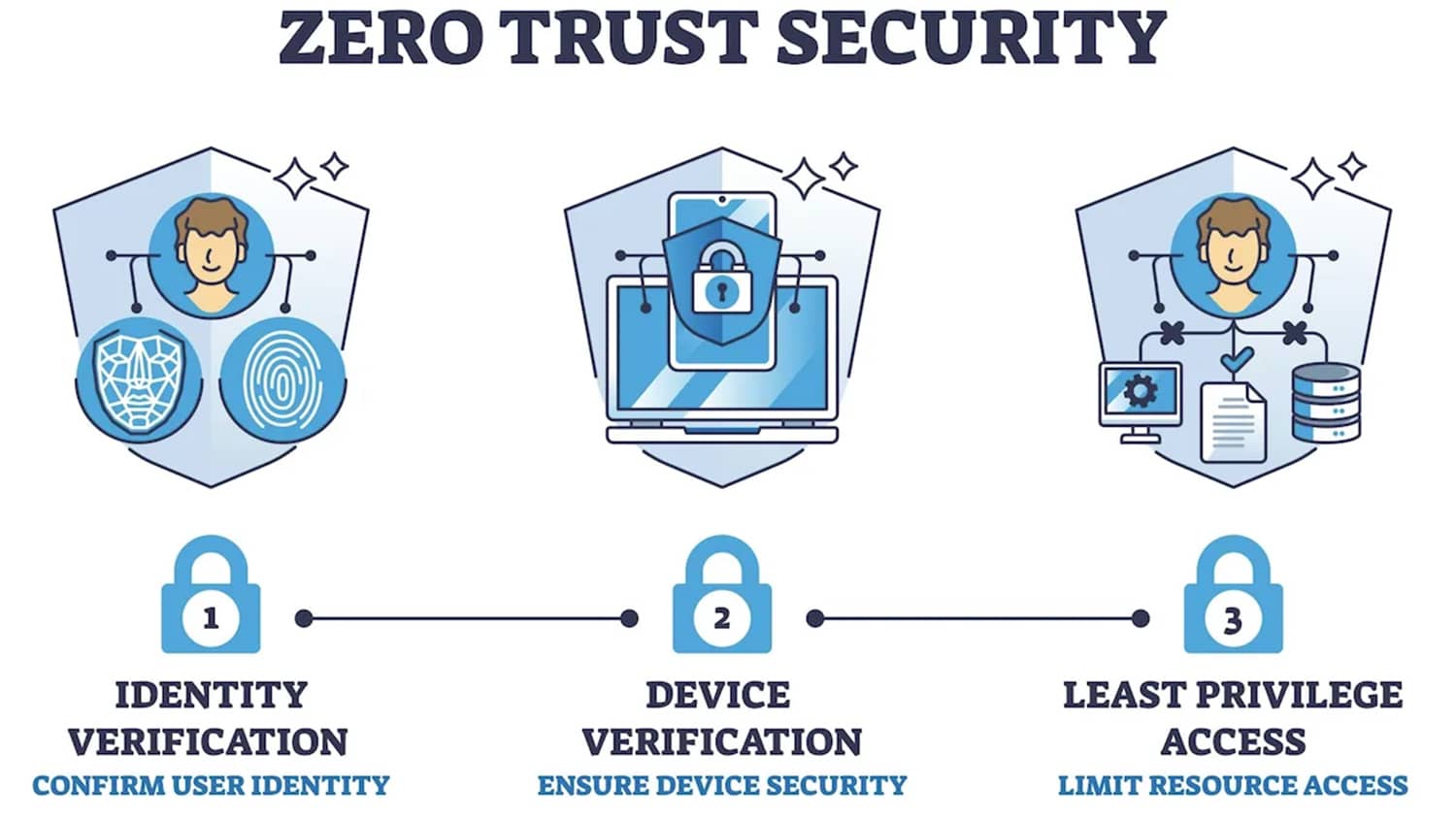
The traditional approach of ‘everything inside the network is secure’ no longer works. The modern concept of Zero Trust requires every request to be verified, regardless of whether it comes from an external user or a top manager at the head office. In this model, trust does not exist by default. The system constantly monitors identity, device status, and connection parameters.
It does not matter where the request comes from – from the office, from home, from an internal segment, or from the cloud. The system must answer three questions each time:
- Who is requesting access (person/credentials)?
- from which device and in what context (is the login device secure, are there any anomalies)
- why and what exactly is needed access to (minimum necessary level)
The transition to Zero Trust involves micro-segmentation of the infrastructure, according to managers at Grymaxion Bulgaria. The entire network is divided into isolated segments with their own access rules. It takes time to integrate new software into outdated systems and adapt processes to new security requirements. This ensures that even if one section is successfully hacked, the attacker will not be able to move further. An additional level of control is provided by privileged access management (PAM) systems, which record every action taken by administrators and engineers at critical points in the company.
Micro-segmentation
There are many solutions on the market that appear to be ‘responses to threats’: SIEM, DLP, IPS, encryption, firewalls, MFA. However, all these tools do not protect, but rather provide manageability: access, privileges, segmentation, monitoring, data control.
The infrastructure of a working enterprise is constantly changing: new services are connected, new integrations are introduced, new employees and new contractors arrive. This means that security must work as a process: maintaining access logic, keeping privileges within limits, monitoring behaviour, limiting the spread of threats, and regularly checking that everything is actually working.
Micro-segmentation, one of the most practical principles of modern protection, can be implemented at different levels: network, virtual, and application. Separate zones are allocated for databases, with access permitted only from application servers.
In a well-designed environment, hacking one segment triggers automatic access to databases, critical services, and administrative areas.

Continuity strategy
Cybersecurity begins with an analysis of business processes. It is impossible to protect everything at once, so it is important to identify critical assets. Constant monitoring of anomalies, such as logging in from an unusual location or downloading large amounts of data, allows threats to be nipped in the bud. Penetration testing reveals hidden vulnerabilities in security systems, code, protection, networks, and even employee behaviour.
Grymaxion EOOD performs dynamic code analysis, simulates cyber attacks, scans for vulnerabilities, and evaluates application architecture. To conduct high-quality and large-scale testing, Grymaxion connects additional resources and outsourced contractors. The use of SQL injection or XSS attack methods allows you to see the system through the eyes of an attacker. During such tests, not only the software is checked, but also the human factor through password hacking and analysis of employee response times.
The three pillars of cybersecurity today
- Trust logic: who can access what and under what conditions, what is considered normal and what is considered abnormal. Without logic, even the most expensive stack becomes a set of buttons that are pressed out of habit rather than for a reason.
- Tools: how this logic is implemented technically. MFA, segmentation, privilege control, monitoring, and data protection must reinforce each other. Otherwise, familiar paradoxes arise: there are signals, but no response; access is formally restricted, but workarounds remain; segments are isolated, but movement within them is still possible.
- Reality check: regular penetration testing.
The final conclusion is unpleasantly simple: a company that thinks its cyber defence is tools and infrastructure will be hacked very soon. Only through regular testing of the architecture for robustness and honest risk assessment can a business move from the illusion of security to real resilience. Grymaxion company does everything to ensure that our customers’ cybersecurity systems work effectively and efficiently, combining Zero Trust, monitoring and penetration testing into a single working circuit.